
Daffodils Preschool in Thane offers early childhood programs in its best prospects. It emphasizes hands‑on, skill‑based learning in a safe and nurturing environment.
Daffodils Preschool in Thane offers early childhood programs in its best prospects. It emphasizes hands‑on, skill‑based learning in a safe and nurturing environment.
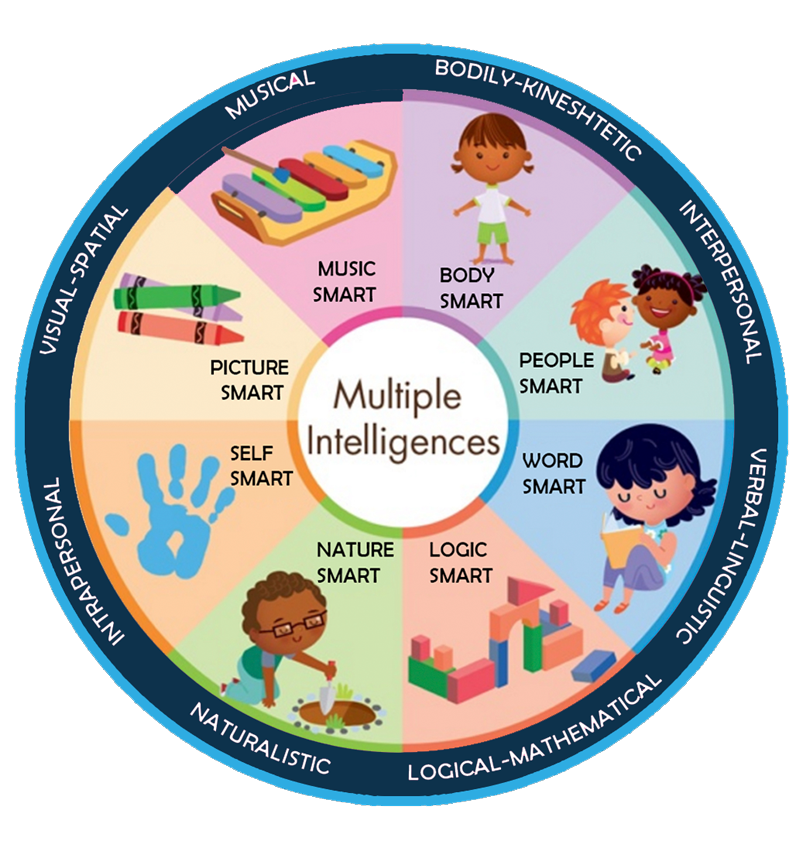
We all have some intelligence that comes more naturally than others. For some of us speaking and writing comes with ease, while some of us are great at socializing and getting along with different kinds of people and for some of us we have a flair at the numbers and resolving problems. Each of us has our own unique strengths and abilities. It’s the same with children too. Every children has their own strengths and these strengths can be used to harness the potential of the child. Dr. Howard Gardner, a psychologist, and professor of neuroscience from Harvard University developed the theory of Multiple Intelligences (MI) in 1983. According to the theory of Multiple Intelligences, there are eight (and a new one added to it recently that makes it 9) different ways of being intelligent. Intelligence is not about what we know, but how we learn.
Today’s world demands multiple skills from successful people. Early exposure to all intelligence’s automatically leads to a more comprehensive development of the child.

The capacity to use language to express what’s on your mind and to understand other people. They think in words more than in pictures. Skills Include – Listening, Speaking, Writing, Storytelling, Explaining, Teaching, Using humor, Understanding the syntax and meaning of words, remembering information, analyzing language usage. Skills Career Choices Include – Poet, Journalist, Writer, Author, Speaker, Translator, Teacher, Orator, Story Teller, Newsreaders, Copywriters or any other profession where language is an important ingredient.

People with strong Body/Kinesthetic Intelligence use/control body movements and objects skillfully, they usually express things through movement. They have a profound sense of eye-hand coordination and balancing. They can remember and process information when given their space and movement. Skills Include – Enjoy creating things, remember things doing rather than hearing or seeing, dancing, physical co-ordination, sports, using body language, crafts, acting, miming, using their hands to create or build, expressing emotions through the body, enjoy adventure sports. Career Choice Include – The most evident examples are people in athletics or the performing arts, particularly dancing or acting. Physical education teachers, sculptors, firefighters.

Individuals who are strong in interpersonal intelligence are good at being aware of their own emotional states, feelings and motivations. They tend to enjoy self-reflection. They understand their inner feelings, dreams, relationships with others, and strengths and weaknesses. Skills include – Recognizing their own strengths and weaknesses, reflecting and analyzing themselves, awareness of their inner feelings, desires and dreams, evaluating their thinking patterns, reasoning with themselves, understanding their role in relationship to others. Career Choice Include – Researchers, Theorists and Philosophers..

People who are strong in logical-mathematical intelligence are good at reasoning, recognizing patterns and analyze problems logically. These individuals tend to think conceptually about numbers, relationships and patterns. They are good at understanding and solving complex computations and also have excellent problem solving skills. Skills Include – Problem solving, classifying and categorizing information, working with abstract concepts, handling long chains of reasoning to make local progressions, enjoy experimenting, performing complex mathematical calculations, working with geometric shapes, reasoning scientifically. Career Choice Include – Scientists, Engineers, Computer programmers, Researchers, Accountants, Mathematicians, etc.

Visually Intelligent people have ability of thinking in terms of visuals, they are good at expressing things visually. They can retain information when presented visually. They prefer looking at maps for directions rather than reading them. Skills Include – Puzzle building, reading, writing, understanding charts and graphs, sense of direction, sketching, painting, creating visual metaphors and analogies (perhaps through the visual arts), manipulating images, recognize patterns easily. Career Choice Include – Navigators, sculptors, visual artists, inventors, architects, interior designers, mechanics, engineers.

Those who have strong interpersonal intelligence are good at understanding and interacting with other people. These individuals are skilled at assessing the emotions, motivations, desires and intentions of people around them. They have the ability to understand other people. It’s an ability we all need, but is especially important for teachers, clinicians, salespersons, or politicians — anybody who deals with other people. Skills Include – Seeing things from other’s perspective, listening with empathy, building trust, peaceful conflict resolution, establishing positive relations with other people, great organizers. Career choice Include – Counselor, Politicians, Human resource professionals, Teachers, Sales people, Business people, Psychologist.

The ability to think in music; to relate to patterns, rhythms, recognize them, and perhaps manipulate them. People who have strong musical intelligence don’t just remember music easily, they can’t get it out of their minds, and it’s so omnipresent. They are extremely sensitive to environmental sounds. Skills Include – Singing, Playing musical instruments, recognizing tonal patterns, composing music, remembering melodies, understanding the structure and rhythm of music. Career Choice Include – Musicians, Composers, Music Directors, Disc jockey, Music Teacher, Movie Composers..

These people have high sensitivity to the natural world. They are more in tune with nature and are often interested in nurturing, exploring the environment and learning about other species. These individuals are said to be highly aware of even subtle changes to their environments. They learn best by studying the natural phenomenon, in a natural setting, learning about how things work. Skills Include – These people are also good at categorizing and cataloging information easily. Enjoy camping, gardening, hiking and exploring the outdoors, preservation and conservation. Career Choice Include – Forest Ranger, Landscaper, Biologists, Naturalists, Geologists, Meteorologist, Farmer, Botanist.

