

Get the complete e-book
All eight chapters — career guidance, revision, memory, mind maps, scholars' secrets, breakthrough plan, SSC past papers and home-study habits — in one beautifully designed PDF you can keep on your phone.
 01 · Career Guidance
Finding Your Path After Std X
The years after Std X are the first real fork in a student's journey. The right choice is not the most popular one — it is the one that fits your interests, your strengths and the kind of work you will enjoy for decades. This guide helps you decide with clarity instead of pressure.
Start with yourself, not the stream
Before comparing Science, Commerce and Arts, spend a week answering three honest questions: What do I enjoy doing even when nobody asks me to? Which subjects feel easy and which feel like a wall? What kind of life do I want — creative, analytical, people-facing, hands-on?
- Interests — what you would happily read about at night
- Aptitude — what you pick up faster than your friends
- Personality — do you prefer people, ideas, things or data?
- Values — stability, creativity, service, income, freedom
The three streams — honestly compared
Each stream opens doors; none closes all of them. Choose by fit, not by fear.
- Science (PCM / PCB): engineering, medicine, pharmacy, architecture, data science, research, defence, aviation. Needs strong Maths or Biology and steady daily practice.
- Commerce: chartered accountancy, company secretary, banking, finance, business management, economics, marketing, entrepreneurship. Needs comfort with numbers and logic.
- Arts / Humanities: law, civil services, journalism, psychology, design, teaching, social work, languages, fine arts, hospitality. Needs reading, writing and curiosity about people.
Careers that did not exist ten years ago
The world of work is changing fast. Keep an eye on fields that reward skills over degrees:
- Artificial intelligence & data analytics
- Cyber security & cloud computing
- UX / product design & animation
- Digital marketing & content creation
- Renewable energy & environmental science
- Sports science, nutrition & physiotherapy
- Allied health — radiology, optometry, lab technology
A simple 5-step decision method
- Shortlist 3 careers that genuinely excite you
- Talk to one real person working in each
- Check the entrance exams and subjects each needs
- Match against your Std X marks and strengths honestly
- Pick the stream that keeps at least two of the three open
Talk to us
St. John's teachers and counsellors are here for exactly this. A twenty-minute conversation with someone who has watched hundreds of students choose well is worth more than a hundred internet forums.
 02 · Study Skills
The Art of Revision
Reading a chapter once and hoping it stays is not revision. Real revision is a system: you meet the same idea several times, at growing gaps, and each time you pull it out of your own head instead of reading it again.
Rule 1 — Recall, don't re-read
Re-reading feels productive because the page looks familiar. Familiar is not the same as known. Close the book and write, say or draw what you remember. The struggle to recall is what fixes it in memory.
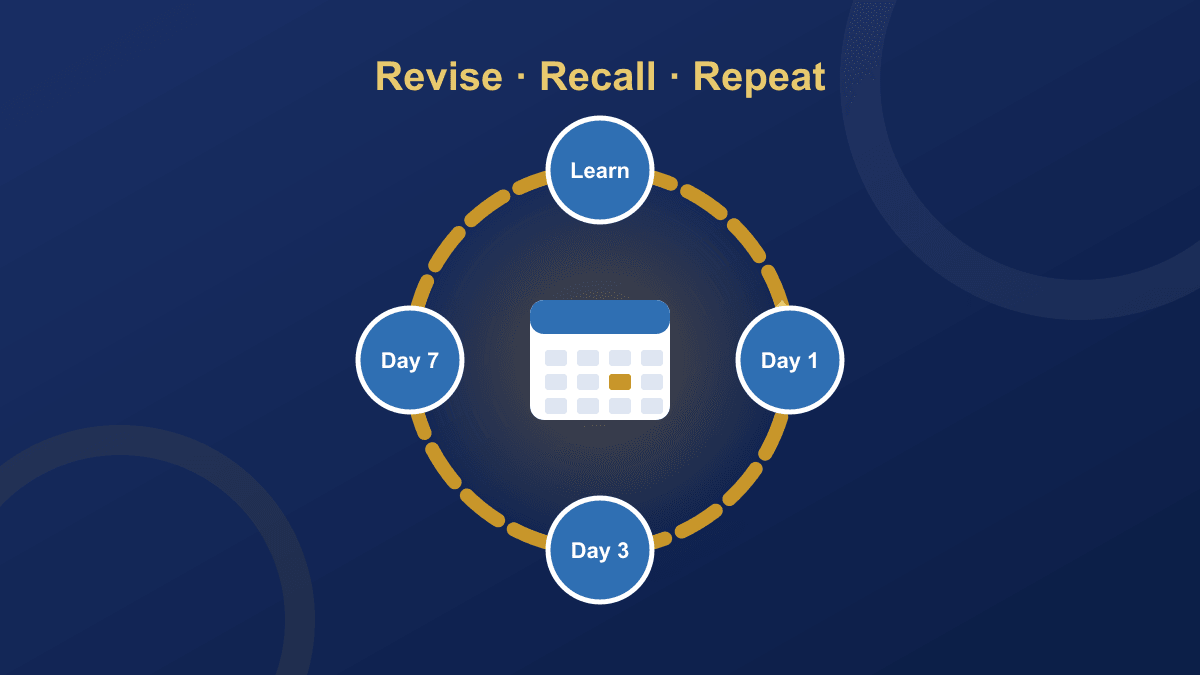
Rule 2 — Space it out (the 1-3-7-21 rule)
Revise a topic on the day you learn it, then after 1 day, 3 days, 7 days and 21 days. Each revision takes less time than the last — five short visits beat one long night.
- Day 0: learn it and make short notes
- Day 1: recall from memory, check gaps
- Day 3: solve 5 questions on it
- Day 7: teach it to someone (or the wall)
- Day 21: one-page summary from memory
Rule 3 — Mix subjects, don't block them
Two hours of only Maths feels efficient but the brain switches off. Alternate: 40 minutes Maths, 40 minutes Science, 40 minutes a language. Switching forces you to reload each subject — which is exactly the practice exams demand.
Rule 4 — Test yourself the way the board tests you
Your revision should look like the exam: timed, written, without notes. Use past papers (see the Board Exam section), mark yourself strictly, and keep an 'error log' of every mistake and why it happened.
A weekly revision planner
- Mon–Fri: 2 subjects per day, 45 min each, recall-based
- Saturday: one full past paper, timed
- Sunday: review the error log + light reading only
- Every night: 10 minutes summarising the day in your own words
 03 · Memory Guidance
Remember More, Stress Less
Memory is not a fixed talent you either have or don't. It is a set of techniques — and every technique here is used by memory champions, doctors and top students alike.
Understand first, memorise second
Facts you understand attach to things you already know; facts you merely repeat float loose and fall out. Before memorising any formula, definition or date, be able to explain it in a sentence a younger student would follow.
Chunking — shrink the load
The mind holds about 4–7 items at once. Group long lists into meaningful chunks: a 12-step process becomes 3 stages of 4; a long formula becomes 'what it is + what it does'.
Mnemonics that actually work
- Acronyms — first letters make a word (VIBGYOR for the spectrum)
- Acrostics — first letters make a silly sentence you cannot forget
- Rhymes & rhythm — sing the periodic table, the dates, the theorems
- Vivid images — the stranger the picture, the stronger the memory
- Number-shape links — 2 is a swan, 8 is a snowman
The Memory Palace
Walk through a place you know perfectly — your home. Place each fact you need in a room, in a memorable, exaggerated image. To recall, simply walk through the house again. Used for centuries; still unbeatable for ordered lists.
The three enemies of memory
- Multitasking — the phone next to your book halves what you retain
- No sleep — under 7 hours and the day's learning is not saved
- Passive study — highlighting and re-reading feel good and do little
 04 · Thinking Tools
Mind Maps: See the Whole Chapter on One Page
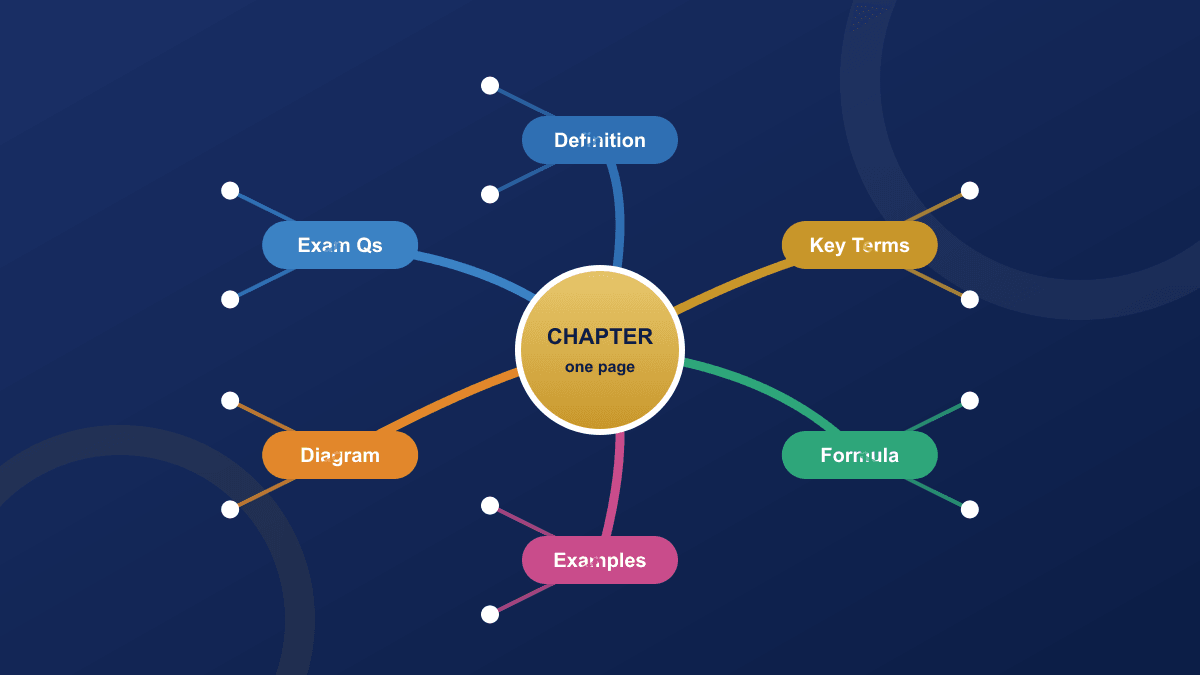
A mind map turns a ten-page chapter into a single picture your brain can hold. Because it mirrors how the mind actually links ideas — branching, colourful, connected — it is one of the fastest revision tools there is.
How to draw one (five minutes)
- Write the chapter name in the centre and circle it
- Draw 4–7 thick branches — one per main idea — in different colours
- Add thinner sub-branches for details, using single keywords, not sentences
- Add a small drawing or symbol wherever you can — images are remembered 6× better than words
- Keep it on ONE page; if it overflows, the chapter needs two maps
When to use a mind map
- Before a test: draw the map from memory, then compare with your notes
- For essays and long answers: plan the points first, then write
- For history and biology: chapters full of names, dates and processes
- For revision week: one map per chapter = the whole syllabus on a wall
Mind map vs. notes
Linear notes are great for capturing a lecture. Mind maps are great for understanding and recalling it. Use both: take notes in class, convert them into a map the same evening.
 05 · Scholars' Secrets
What Toppers Do Differently
Toppers are rarely the students who study the longest. They are the students who study the smartest — and their habits are surprisingly simple to copy.
Ten habits of consistent high scorers
- They study at the same time every day — the habit removes the decision
- They start with the hardest subject while the mind is fresh
- They finish homework the day it is set, so revision is real revision
- They keep an error log and re-attempt every wrong question
- They ask questions in class — confusion cleared in 2 minutes saves 2 hours
- They write answers, not just read them — boards mark writing
- They use past papers from the first month, not the last
- They sleep 7–8 hours and treat it as part of studying
- They keep the phone in another room during study blocks
- They revise in short daily doses rather than weekend marathons
The 'teach it' test
The single most reliable secret: if you can teach a topic to a friend without notes, you know it. If you stumble, you have found the exact gap. Toppers do this constantly — with siblings, friends, even the mirror.
Presentation earns marks
- Underline key terms and formulas
- Number your points; use diagrams wherever the question allows
- Leave a line between answers; write neatly even under time pressure
- Read the question twice — half of lost marks come from answering the wrong thing
 06 · Turnaround
Why Students Fail — and How to Break Through
Almost nobody fails because they are not intelligent enough. Students fail for a handful of very ordinary, very fixable reasons. Naming the real reason is half the cure.
The seven real reasons behind poor marks
- Cramming — learning everything in the last two weeks, so nothing is truly learned
- No plan — studying whatever feels easiest, skipping what feels hard
- Passive study — reading and highlighting instead of writing and solving
- Fear of the subject — one bad test becomes 'I am bad at Maths' for years
- Distraction — the phone, the group chat, the notification every four minutes
- Not asking — sitting silently with a doubt for weeks
- Exam anxiety — knowing the answer at home and blanking in the hall
The breakthrough plan (30 days)
- Week 1 — Diagnose: sit one old paper per subject, list every weak topic honestly
- Week 2 — Rebuild basics: go back to the chapter where it stopped making sense; no shame in starting earlier
- Week 3 — Practise daily: 5 questions per weak topic, error log every evening
- Week 4 — Simulate: two full timed papers, marked strictly; celebrate every improvement
Beating exam anxiety
Anxiety is the body's alarm for the unprepared — so preparation is the first cure. Beyond that: breathe in for 4 counts, hold 4, out for 6, three times before opening the paper. Start with the question you know best to build momentum. And remember — one exam is a checkpoint, never a verdict on you.
A word to parents
A child who fears disappointing you hides doubts instead of asking. Praise effort and improvement, not only the rank. The question 'What did you learn today?' does more for marks than 'How much did you score?'
 07 · SSC Board Exam
SSC Question Papers — Multiple Years
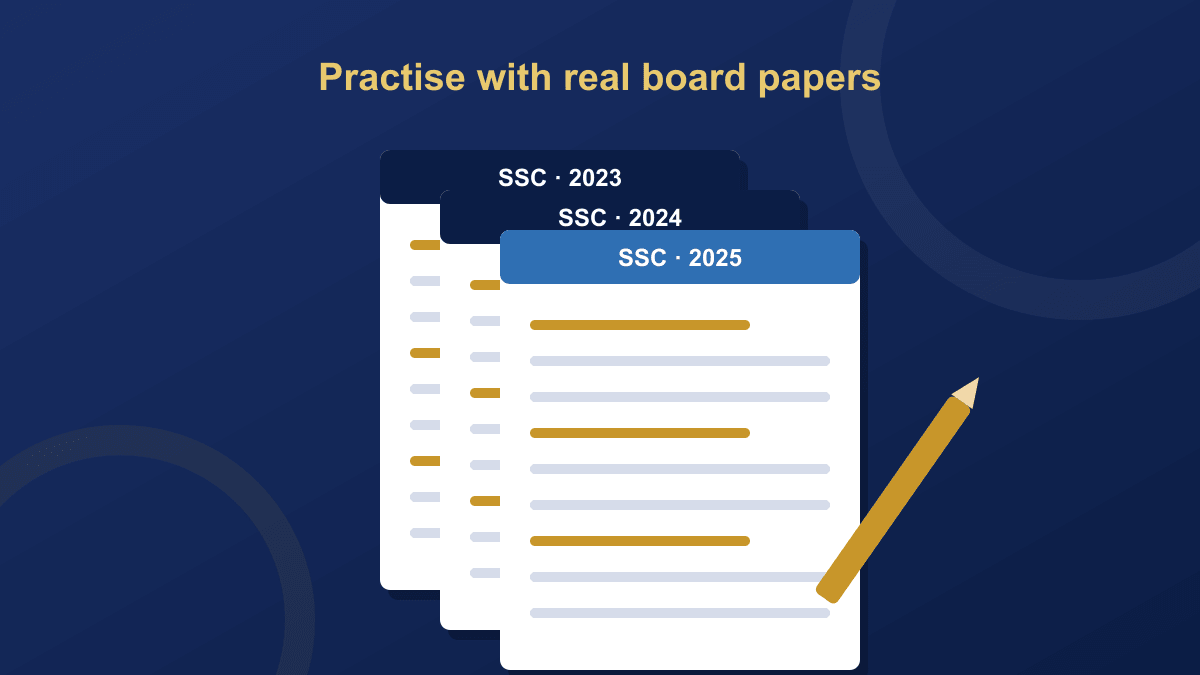
Nothing prepares you for the SSC board exam like the board's own past papers. They show the pattern, the weightage, the style of questions and the timing — the exact things textbooks cannot. Here is how to use Std X papers from previous years, and where to find them.
SSC question papers by year
Tap a year to open the Maharashtra State Board of Secondary & Higher Secondary Education archive. Practise the most recent five first.
Std X subjects covered
Where to get the official papers
The Maharashtra State Board of Secondary & Higher Secondary Education publishes previous years' question papers on its official website. Always use the official papers — they are the only ones that exactly match the pattern you will face.
- Maharashtra State Board (official website) — https://mahahsscboard.in
- Ask the St. John office / class teacher for the school's paper set
- Your subject teacher can share topic-wise question banks
How to practise with past papers (the right way)
- Start 4–5 months before the exam, not 4–5 weeks
- Sit the paper in exam conditions: full time, no notes, no phone
- Mark it strictly with the marking scheme — no half-credit for 'I knew it'
- Log every lost mark: concept gap, careless slip, time ran out, or misread question
- Re-attempt only the wrong questions three days later
- Track your score paper by paper — the upward line is your confidence
Reading the pattern
After three papers you will notice the same chapters carrying the same weight year after year. Give those chapters proportionate time — but never skip a chapter entirely; boards do rotate.
 08 · Home Study
Home Study, Revision & Healthy Habits
School gives you six hours a day; the other few hours at home decide the rest. A calm, well-designed home routine turns those hours into your biggest advantage — without exhaustion.
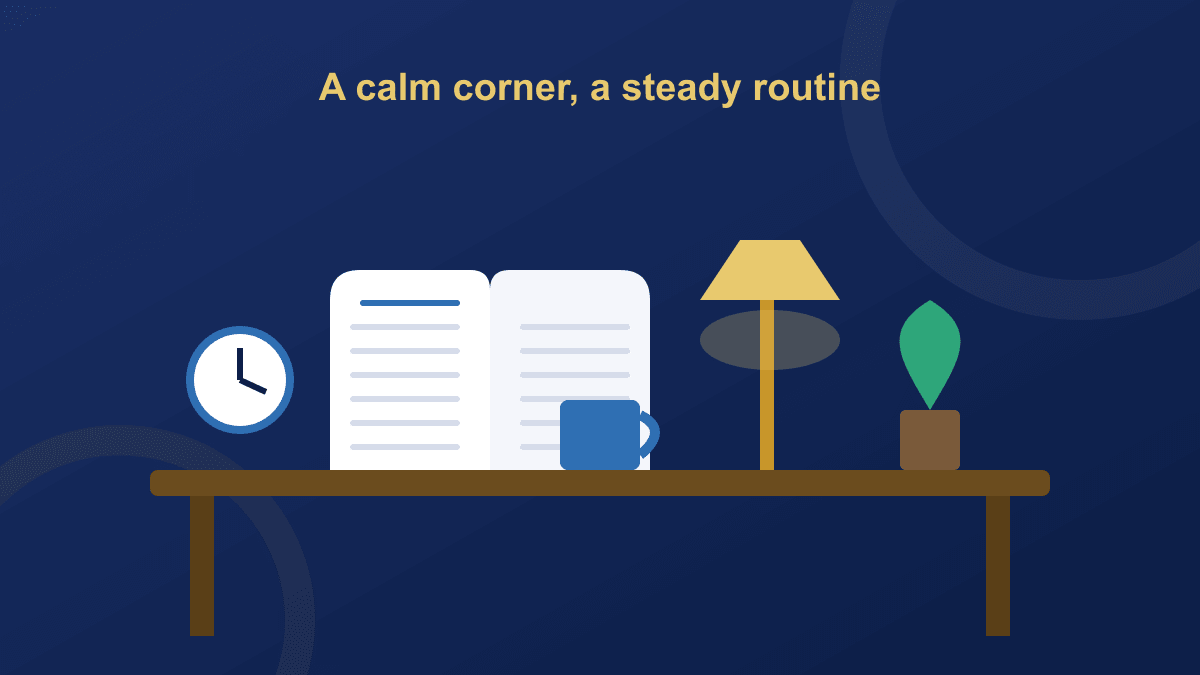
Set up a study corner that works
- One fixed place — the brain learns 'this is where I focus'
- Good light from the side; a chair that keeps your back straight
- Only today's books on the desk — everything else out of sight
- Water bottle within reach; phone in another room
- A small clock or timer for study blocks
A realistic daily timetable
- Return from school: 30–45 min rest, snack, no screens
- Block 1 (45 min): the hardest subject / homework
- Break (15 min): walk, stretch, help at home
- Block 2 (45 min): revision using recall
- Block 3 (30 min): a language or light subject
- Evening: play, family, dinner — not study
- Before bed (10 min): tomorrow's plan + one-line summary of today
Study skills every student needs
- Note-making: keywords and diagrams, not copied paragraphs
- Reading for meaning: question the heading before you read the section
- Time management: 'What is the ONE thing I must finish today?'
- Self-testing: close the book, write, check
- Organisation: one folder per subject; a weekly clean-up
Habits that quietly raise marks
- Sleep 8 hours — memory is filed while you sleep
- Breakfast every day; brains run on food
- 30 minutes of physical activity — better focus, lower stress
- Screens off 45 minutes before bed
- One day a week with lighter study — rest is part of the plan
For parents: how to help without pressure
Provide the quiet corner and the routine; then step back. Ask about learning, not marks. Notice effort. Keep exam season calm at home — a stressed house produces a stressed student. And keep the lines open with St. John — teachers see things at school that you cannot see at home.
Keep this guide with you
Download the full e-book and revisit it before every exam season. Our teachers and counsellors at St. John High School are always happy to help.
⬇ Download E-Book (PDF)